Every e-commerce dashboard knows more about a single Tuesday afternoon than most physical retailers know about their entire year. Online, every glance is a data point: impressions, hovers, carts, exits, returns. Offline, the same customer walks through a store, considers your product for eleven seconds, puts it back, and leaves behind exactly nothing. The industry calls it the last analytics blind spot. I call it a hardware problem, and hardware problems have hardware answers.
The camera trap
The reflex answer is cameras. Point lenses at the aisle, run vision models, count faces and dwell. And it's the wrong answer, for reasons bigger than compliance: under the GDPR, video of identifiable people is personal data, facial analysis flirts with biometric territory, and the consent you'd need is impossible to collect at a shelf. Beyond the law sits the brand problem: nobody wants to be filmed while deciding between two shampoos, and one privacy headline costs more than any dashboard is worth.
Here's the reframe: you never needed identity. Advertising doesn't convert because it knows a shopper's name. It converts because it understands interest. And interest, it turns out, is physical. It has distance, speed, direction, duration, and hands.
You don't need to know who the shopper is. You need to know your shelf made them stop.
Measuring interest, not people
A distance sensor costs a few euros and reads one thing: how far a body is from the shelf, many times per second, with no image, no face, no identity. Nothing that can ever become personal data, because a distance reading is anonymous by physics. Combine a handful of them and the invisible becomes a funnel: passed (someone walked by), paused (their speed dropped), approached (under a metre), engaged (a motion sensor caught the reach), picked up (an accelerometer in the display or a weight pad under the product fired), carried or returned. Six stages. That's an offline conversion funnel, identical in shape to the one your webshop already has.
Suddenly a shelf has a bounce rate. A product has a pick-up-to-purchase ratio. An end-cap display has dwell time per hour of the day. The dark part of the customer journey lights up, without a single pixel of anyone's face.
Displays that answer back
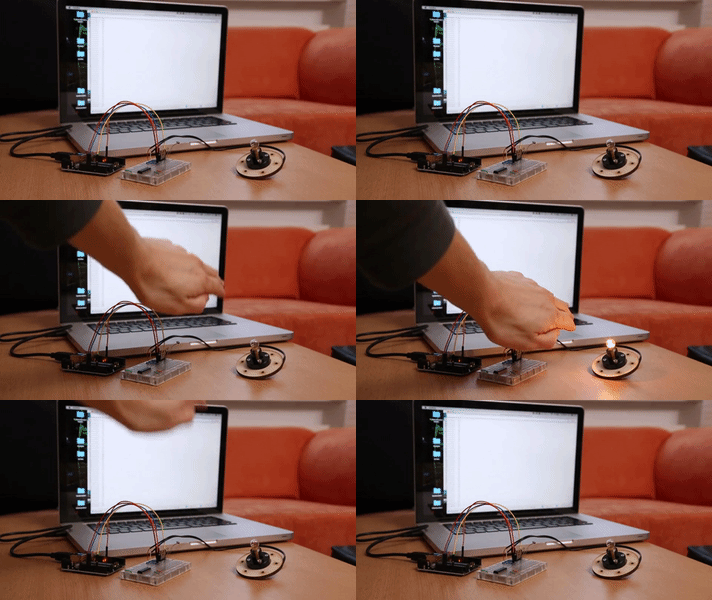
Measurement is only half of what the same sensors buy you. The other half is theatre. If the shelf knows someone slowed down, it can act on it: the screen switches from an ambient loop to the product story. On approach, lights lift and the one claim that matters appears. On pick-up, the display answers the exact question every shopper is holding in their hand: what is this, why this one. The installations I've built for shops and brands keep teaching the same lesson: the trigger matters more than the content. The very same fifteen-second video that gets ignored on an endless loop converts when it plays as a response to a gesture, because now it's a conversation, not wallpaper.
Feeding the ad machine
This is where it stops being a gadget and starts being marketing infrastructure. Once you can count interactions per hundred passers-by, per product, per hour, offline data starts driving advertising the way clickstreams do online. A campaign flight starts and pick-ups don't move? The creative isn't working, whatever the awareness study says. Two packaging designs on the real shelf for two weeks each: that's an A/B test with stakes, run before you commit the print run. Interest peaking Thursdays at six? Time your retail media and staffing to it. Shoppers touch the product but don't buy? The problem is price or claim, not attention, and your next campaign should say something different. The shelf becomes the most honest analytics property you own.
And yes, the packaging still talks
The pack itself remains a layer of the same stack: an NFC tag for authentication and reorders, per-unit QR codes for scan analytics and grey-market detection, printed temperature strips that prove the cold chain held. Cheap, useful, proven. The division of labour is neat: the packaging speaks to the one person holding it; the sensors listen to everyone else.
How I'd start
Not with a chain-wide rollout and a procurement committee. One shelf, one store, one month. A distance sensor, a motion sensor, a pick-up pad, a small screen, a dashboard: workshop-grade hardware, a few hundred euros, built and installed in days. By week two you know which claim stops people. By week four you have an offline funnel your media agency has never seen in its life. Then, and only then, you scale what worked.
the takeaway
Interest is measurable without ever pointing a camera at a face. Start with one instrumented shelf: distance, motion, pick-up. Within a month you'll have an offline funnel, and your first advertising decisions driven by what shoppers actually touch.